
Sustainable events — what does that actually mean?
Numbers, not buzzwords. Shares, kilometres, tonnes of CO₂. And a few areas where we deliberately do not present ourselves as greener than we are.
Where the footprint is actually created.
An outdoor wedding or a corporate retreat can appear inherently sustainable at first glance — nature, fresh air, a regional aesthetic. When you measure honestly, the picture is more nuanced. Three levers determine over 90 percent of the impact.
1. Travel (60–75% of the carbon load)
By far the largest line item. A 60-person wedding in Bavaria typically generates 3 to 5 tonnes of CO₂ from guest travel alone; a destination wedding involving flights more like 10 to 18 tonnes. What can be concretely reduced: shared shuttle solutions from the nearest train stations (Munich-Holzkirchen, Toulouse, Olbia) and a recommendation for rail travel. A wedding with predominantly rail and shuttle arrivals typically sits 40–60 percent below the all-car scenario.
2. Catering (15–25% of the carbon load)
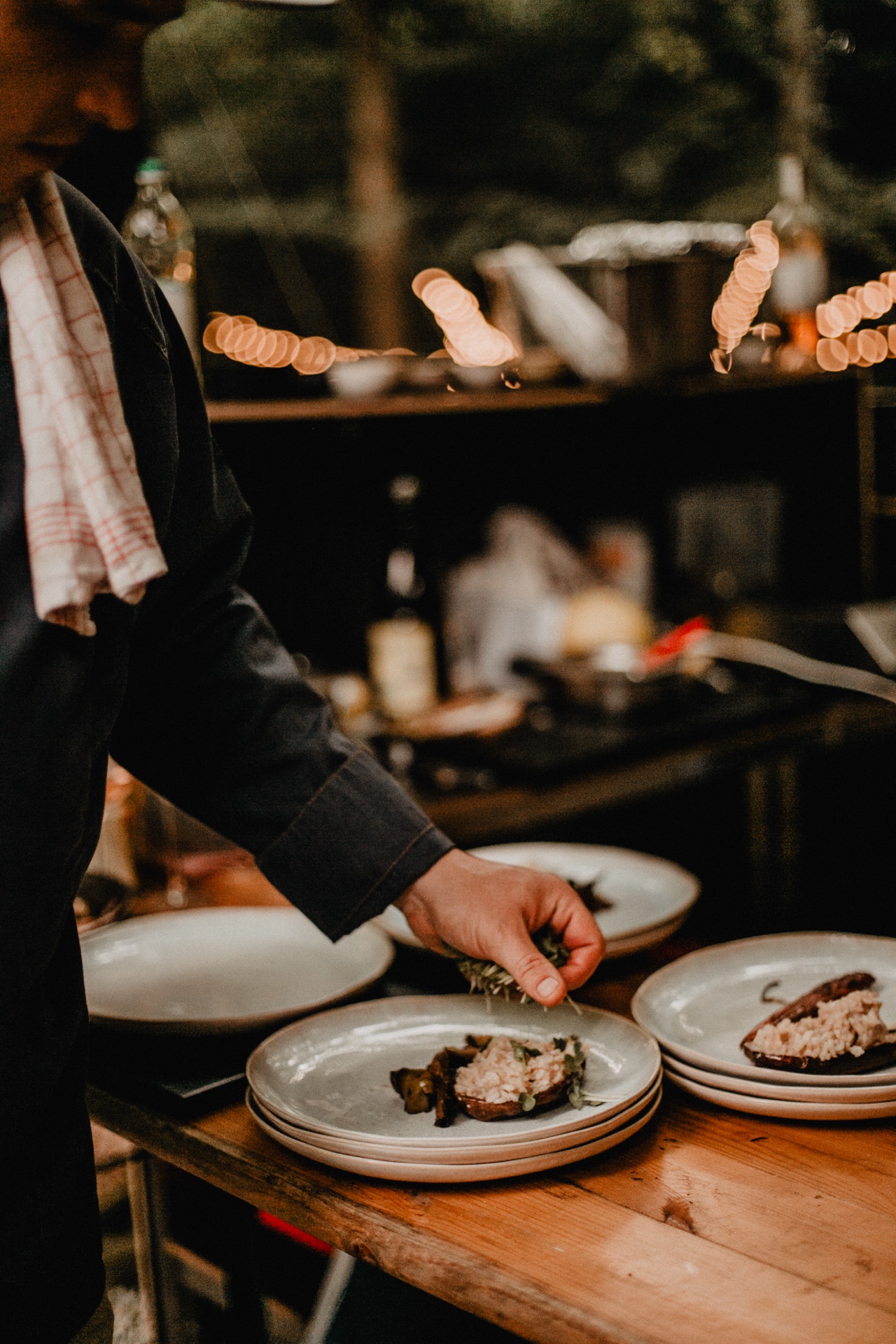
Three adjustment points: the share of regional produce (benchmark: over 70 percent by spend on goods), the share of plant-based courses (at least one substantial plant-based main course), and minimising food waste through realistic rather than oversized quantity planning.
In practice: we curate caterers by region and short supply chains. The origin of individual products can be discussed directly with the chosen caterer on request.
3. Materials management (5–15%)
Rental furniture instead of single-use, cloth napkins instead of paper, glass bottles instead of plastic. Floristry preferably without plastic floral foam — we recommend floristry partners who work with seasonal flowers sourced locally. For wedding flowers out of season (e.g. peonies in autumn) imports are often unavoidable.
What greenwashing looks like.
When a provider claims to be "climate neutral" without stating the actual footprint — greenwashing. When "regional" is used without defining a radius or percentage — greenwashing. When CO₂ is offset via projects that are difficult to verify and have no certification standard — greenwashing.
Credible offsetting runs through established standards such as Gold Standard or Verra/VCS. More important than offsetting, however, is consistent reduction: travel, catering, materials — in that order.
Where we deliberately do not present a green picture.
- Le Bétet and Sardinia are only realistically reachable by air — we do not conceal this, and we recommend multi-day formats to reduce the per-day footprint.
- Air conditioning in Sardinia runs in high summer — we use it rather than pretending we can manage without it.
- Offsetting is not a substitute for reduction. Once you have reduced what can be reduced, you can offset the remainder — not the other way round.
More on sustainability in practice: Sustainable Events at Thrive Outside. Wedding cost range: Outdoor Wedding Bavaria.